Key Takeaways
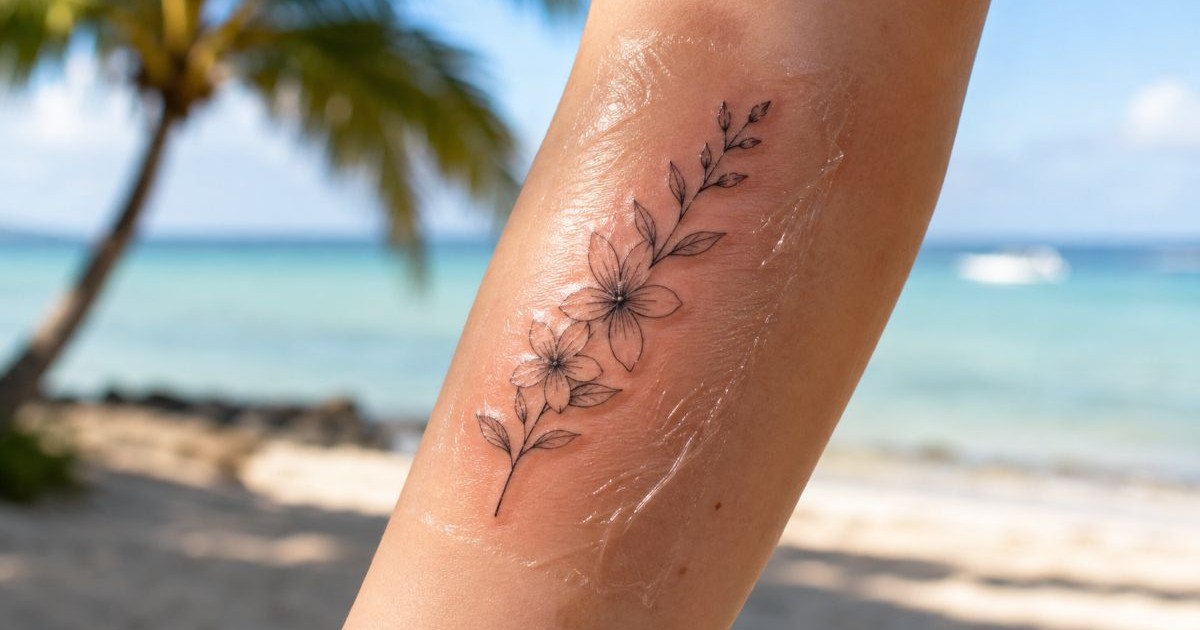
In Mauritius' tropical climate, keep a healing tattoo out of direct sun and out of the sea and swimming pools for the first two to three weeks, until the surface has fully healed. The outer skin heals in about two weeks and the deeper layers over four to six. Wash gently twice a day with unscented antibacterial soap, apply a thin layer of aftercare product, avoid heavy sweating, and don't scratch or pick. High humidity can slow healing, so keep the tattoo clean and dry between washes. After it heals, apply SPF 50+ to the tattoo every time it is exposed — for life — because sun is the single biggest cause of fading in Mauritius. If you are on holiday, time your tattoo for the start or end of your trip and plan around the water.
On this page
Key Takeaways
A fresh tattoo in Mauritius heals on the same biological clock as anywhere else — the outer skin closes in about two weeks, with the deeper layers settling over four to six — but the tropical climate stacks the odds against it. Strong UV, salt water, high humidity, constant heat and mosquitoes all work against a healing tattoo. The non-negotiables for the first two to three weeks: keep it out of direct sun, stay out of the sea and pools, avoid heavy sweating, and wash gently twice a day. After that, sunscreen (SPF 50+) on the tattoo for life is the single most important thing you can do to keep it sharp. If you're on holiday, time your tattoo for the start or end of your trip and plan around the water. Every Glamour client leaves with written aftercare and a free healing check.
Most tattoo aftercare advice is written for cooler, drier places. It tells you to keep the tattoo clean and out of the sun and leaves it there — which is fine in Manchester or Munich, and nowhere near enough in Grand Baie. After two decades tattooing on this island, I've learned that the climate is the part people underestimate, and it ruins more tattoos here than anything else. This is the version I wish every client read before they walked out the door.
Why aftercare in Mauritius needs extra care
A healing tattoo is an open wound. For the first couple of weeks, your skin is sealing itself and locking the ink into the dermis. Anything that interferes with that process — bacteria, UV, friction, moisture sitting on the skin — shows up later as faded colour, blurred lines, patchy healing, or in the worst case an infection.
Mauritius throws all of those at you at once. The sun is strong enough year-round to bleach healing ink in a single afternoon. The sea and the hotel pool are full of bacteria a fresh tattoo can't defend against. The humidity keeps your skin damp, which slows healing and invites irritation. The heat makes you sweat, and salt sitting on a wound stings and softens scabs before they're ready. None of this means you shouldn't get tattooed here — it means the aftercare has to account for where you are. For the wider picture on getting tattooed on the island, see our complete guide to tattoos in Mauritius.
How a tattoo heals: the timeline
Healing isn't one event, it's a sequence. Knowing what's normal at each stage stops you panicking over things that are fine — and helps you spot the things that aren't.
Days 1–3: the fresh wound
The tattoo is raw, sore, and may weep a little plasma and ink — that's normal. If you're wearing a second-skin film, fluid may collect underneath; that's the film doing its job. Keep it clean, keep it covered as your artist instructed, and resist the urge to fuss with it.
Days 4–14: peeling and itching
The surface starts to dry, flake and peel like mild sunburn. It will itch. Do not scratch and do not pick the flakes — let them fall off on their own. Picking pulls ink out with the scab and leaves light patches. This is the stage where the climate does the most damage, because heat and sweat make the itch worse and the temptation to scratch stronger.
Weeks 2–6: settling
The outer skin is closed but the deeper layers are still healing. The tattoo may look slightly dull or shiny under a layer of new skin — it sharpens up as it settles. You can return to most normal activity, but the sun rule still applies (see below).
Beyond 6 weeks: healed, for life
Once fully healed, the only ongoing job is sun protection. A tattoo you protect from UV stays crisp for decades; one you don't will fade and blur far faster in this climate than it would anywhere cooler.
Swimming, the sea and pools: when is it safe?
This is the question every visitor asks, and the answer people least want to hear: no swimming until the tattoo is fully healed on the surface — realistically two to three weeks, sometimes longer in humid conditions.
That means no sea, no swimming pool, no lagoon, no jacuzzi, and no long soaks in the bath. Salt water and chlorinated water both carry bacteria, and both soften and lift scabs before they're ready, which pulls ink out and risks infection. The warm, still water of a hotel pool is a particularly good place for bacteria to grow.
Short, lukewarm showers are fine from day one — just don't soak the tattoo or blast it with a hot, high-pressure jet. When you do get back in the sea after healing, rinse the tattoo with fresh water afterwards and dry it gently.
Many professional studios, including ours, finish a tattoo with a waterproof second-skin film — we use Dermalize. It shields the fresh tattoo from dirt and friction and lets you shower normally from day one, but it's built for showering, not swimming: don't take it as a licence to submerge fresh ink. If your trip is water-heavy, raise it at the consultation and we'll advise on timing.
If the whole point of your trip is the water, that doesn't rule out a tattoo — it just means timing it deliberately. See the section on holiday timing below.
Sun and SPF: protecting your tattoo for life
If you remember one thing from this guide, make it this: the Mauritian sun is the single biggest threat to your tattoo, short-term and long-term.
For the first two to three weeks the rule is absolute — no direct sun on the healing tattoo at all. UV destroys ink while it's settling and can leave you with a permanently faded, washed-out result before the tattoo has even healed. Keep it covered with loose clothing whenever you're outside.
Once it's healed, the tattoo is yours for life — but the sun never stops working on it. Every time the tattoo is exposed, apply a high-factor sunscreen (SPF 50+). This isn't a healing-period instruction, it's a forever one. The faded, blue-grey old tattoos you see on people who've spent their lives in the sun are almost always tattoos that were never protected — and in a climate like ours that fading happens years faster. A few seconds of sunscreen each time is what keeps black sharp and colour alive.
Heat, humidity, sweat and mosquitoes
The things that make Mauritius beautiful are the same things that complicate healing.
Humidity keeps the skin damp and slows the drying-and-peeling stage. Keep the tattoo clean and dry between washes, wear loose breathable cotton over it, and don't smother it in thick ointment that traps moisture — a thin layer of the product your artist recommends is plenty.
Heat and sweat are a problem because the salt and bacteria in sweat irritate an open wound and soften scabs. Skip the gym, running, and anything that makes you sweat heavily for the first week to ten days. If you do get sweaty, rinse gently with fresh water and pat dry.
Mosquitoes are the one nobody warns you about. A bite on or next to a healing tattoo is miserable, because you can't scratch it without damaging the work. Use repellent around — not directly on — the fresh tattoo, sleep under a net or with the air conditioning on if bites are a problem, and keep the area covered in the evenings.
Your daily aftercare routine
The routine itself is simple. Doing it consistently in a hot climate is the hard part.
- Wash gently twice a day with clean hands and an unscented, antibacterial soap. Lukewarm water, no scrubbing, no washcloth.
- Pat dry with a clean paper towel or let it air-dry. Don't rub, and don't use a towel that's been hanging in a humid bathroom.
- Apply a thin layer of the aftercare product your artist gives or recommends. Thin is the word — a healing tattoo needs to breathe, especially in humidity. More cream is not better.
- Wear loose cotton over the area. Avoid anything tight, synthetic, or that rubs.
- Leave it alone otherwise. No scratching, no picking, no peeling, no "just checking."
Most studios, including ours, send you home with written instructions and the right product. If you've lost the instructions or you're unsure about anything, message the studio — we would always rather answer a question than see a tattoo heal badly.
Getting tattooed on holiday: how to time it
Plenty of visitors get tattooed in Mauritius — a meaningful souvenir of a honeymoon, a milestone, or simply a trip you don't want to forget. The trick is fitting the tattoo around the two parts of the holiday that clash with healing: sun and water.
There are two sensible approaches:
Get it early. Have the tattoo done in the first day or two, then plan shaded, indoor, or low-key activities for the first week — and save the heavy beach and pool days for the back half of your trip, by which point the surface has healed. This works well on longer stays.
Get it late. Have the tattoo done toward the end of your trip, enjoy the water first, and protect the fresh tattoo for the flight home and the days after. A long-haul flight with a day-old tattoo is manageable — keep it covered, clean and moisturised, and stop the seat or tray rubbing against it.
What doesn't work is getting tattooed mid-trip and then heading straight to the beach. If you only have a few days and they're all built around the water, it may be better to plan the tattoo for your next visit. We'll always give you honest advice on timing at the consultation rather than just taking the booking.
When something's wrong: warning signs
Some redness, swelling, warmth and tenderness around a fresh tattoo is normal for the first few days. What's not normal — and worth getting checked — is any of the following:
- Spreading redness that gets worse after day three or four rather than better
- Swelling that increases instead of settling
- Pus or foul-smelling discharge (a little clear or ink-tinged plasma early on is fine; thick yellow-green discharge is not)
- A fever, chills, or feeling generally unwell
- A rash, hives, or intense itching that could signal a reaction to the ink or product
Infections are uncommon when a tattoo is done in a clean, professional studio and cared for properly — which is exactly why hygiene at the studio and aftercare at home both matter. You can read more about what a clean, professional studio should look like in our guide to tattoo hygiene and safety. If you're worried, see a doctor or pharmacist; in Mauritius both are easy to reach, and a quick check is always better than waiting it out.
FAQ
How long after getting a tattoo can I swim in Mauritius?
Wait until the tattoo is fully healed on the surface — realistically two to three weeks, and longer in very humid conditions. That covers the sea, swimming pools, the lagoon, jacuzzis and long baths. Salt water and chlorinated water both carry bacteria and lift scabs before they're ready, which pulls out ink and risks infection. Short, lukewarm showers are fine from day one.
Can I sunbathe with a new tattoo on holiday?
No. Keep a healing tattoo out of direct sun completely for the first two to three weeks — UV bleaches ink while it's settling and can permanently fade a tattoo before it has even healed. Once it's healed you can be in the sun again, but apply SPF 50+ to the tattoo every single time it's exposed, for life.
How long does a tattoo take to heal in a tropical climate?
The outer skin closes in about two weeks and full healing takes four to six. High humidity can slow the surface stage slightly, because the skin stays damp for longer. Keeping it clean, dry between washes, and lightly moisturised helps it move through the stages cleanly.
Will the Mauritian sun fade my tattoo?
Yes — sun is the number one cause of tattoo fading here. Unprotected tattoos fade and blur years faster in this climate than in cooler countries. A high-factor sunscreen on the tattoo whenever it's exposed is the single best thing you can do to keep it sharp.
What's the best aftercare product to use in this climate?
Use whatever your artist gives or recommends, and apply it in a thin layer — a healing tattoo needs to breathe, especially in humidity, so thick ointment that traps moisture does more harm than good. There's no need for expensive specialist products; a simple unscented aftercare balm used sparingly is ideal.
Do mosquitoes affect a healing tattoo?
They can be a real nuisance, because a bite on or near a fresh tattoo itches badly and you can't scratch it without damaging the work. Use repellent around the area rather than directly on the fresh tattoo, keep it covered in the evenings, and sleep under a net or with air conditioning if bites are a problem.
Can I go to the gym or exercise after a new tattoo?
Avoid heavy sweating for the first week to ten days. Sweat carries salt and bacteria that irritate an open wound and soften scabs, and friction from equipment or clothing doesn't help. Light movement is fine; intense, sweaty workouts are not until the surface has healed.
How do I wash a new tattoo?
Wash it gently twice a day with clean hands and an unscented antibacterial soap, using lukewarm water and no scrubbing. Pat it dry with a clean paper towel or let it air-dry, then apply a thin layer of aftercare product. Never use a washcloth or a shared towel from a humid bathroom.
Can I get a tattoo on holiday and still enjoy the beach?
Yes, with planning. Either get the tattoo early in your trip and keep the heavy beach and pool days for the second half, once the surface has healed, or get it at the end and protect it on the journey home. What doesn't work is getting tattooed mid-trip and going straight into the sea. We'll advise on timing at your consultation.
How do I know if my tattoo is infected?
Some redness, warmth and tenderness is normal in the first few days. Warning signs are redness or swelling that worsens after day three or four, thick yellow or green discharge, a bad smell, a fever, or feeling generally unwell. Infections are uncommon with a clean studio and good aftercare, but if you're worried, see a doctor or pharmacist — both are easy to reach in Mauritius.
Every Glamour client leaves with written aftercare guidance, the right product, and a free healing check a few weeks later — because a tattoo is only as good as the way it heals. If you're planning a tattoo in Mauritius and want honest advice on timing it around your trip, book a free consultation.
This guide was written by Vicky Mannick, master tattoo artist and founder of Glamour Tattoo Studio in Grand Baie, Mauritius, drawing on over 20 years of professional tattooing experience. Last reviewed June 2026.
By Vicky Mannick
Master Tattoo Artist & Studio Owner
Master tattoo artist with over 20 years of experience, specialising in Polynesian, Maori, realism and custom tattoo work. Founder of Glamour Tattoo Studio in Grand Baie, Mauritius.
Ready to book your consultation?
Talk through your idea with Vicky and the team — free consultation, firm quote before any work begins.
Book a consultationMore from the guide
More guides coming soon.